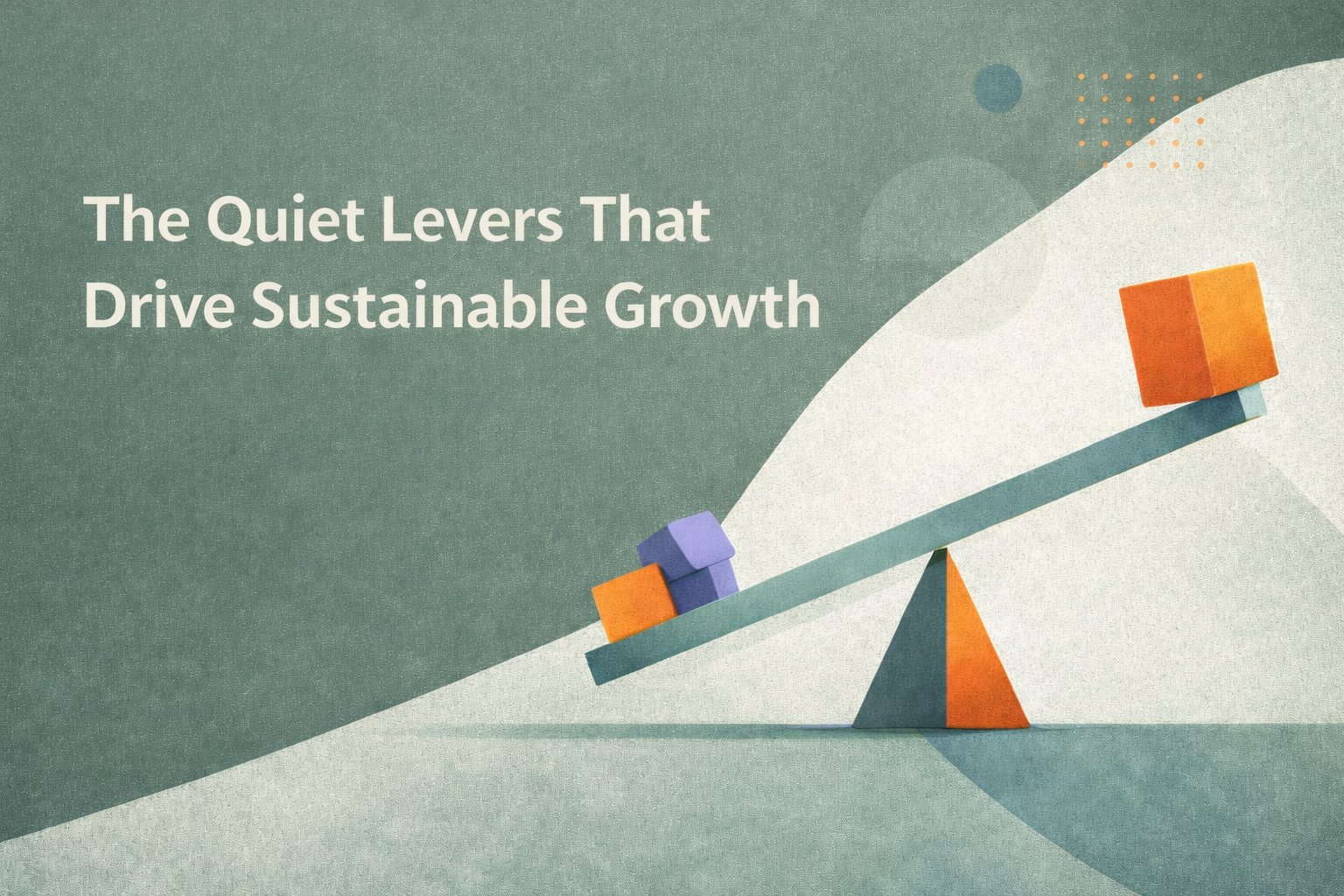
The Quiet Levers That Drive Sustainable Growth
Why consistency, clarity, and alignment create momentum over time
Introduction
Most growth conversations focus on large initiatives. New markets, product launches, big campaigns, investment in tools, or major strategic shifts. Those efforts can be important, but they are rarely what makes an organization truly sustainable over time. In most cases, long-term growth comes from quieter changes that strengthen how the organization works, communicates, and makes decisions.
Across many teams and industries, we see the same pattern. Growth becomes harder when organizations rely on effort instead of structure, and motion instead of direction. The work gets done, but it requires constant adjustment and individual problem-solving. Progress happens, but it does not compound.
Sustainable growth tends to look different. It is usually the result of small but meaningful shifts in clarity, alignment, expectations, and consistency. These are not dramatic changes. They do not draw attention. But over time, they build stability, confidence, and trust — both inside the organization and with the clients it serves.
This article explores those quieter levers and why they matter when growth is meant to last.
Sustainable growth is built from small, reinforcing changes
Big growth initiatives create visibility. Quiet growth levers create resilience.
Organizations that sustain growth over time tend to strengthen areas that do not always appear strategic on the surface, but that influence everything else around them. Those areas include:
- how the organization describes its value and priorities
- how decisions are made and communicated
- how expectations are set and reinforced
- how knowledge and responsibility are shared across teams
Individually, each change can feel incremental. Together, they reduce friction, improve predictability, stabilize delivery, and increase capacity without adding chaos. The organization does not just grow. It grows in a way that feels healthier and more durable.
There is also support for this approach in broader management research. Studies highlight that organizations with strong internal clarity and alignment outperform those that rely primarily on activity or output-driven growth. Deloitte has published research on how organizational clarity improves performance and long-term stability, which you can read here: Organizational clarity and sustainable performance (Deloitte Insights).
These findings align with what many leaders experience in practice. Sustainable growth rarely comes from dramatic change. It comes from strengthening the foundation of how the organization works.
The first quiet lever: clarity of direction and purpose
One of the biggest sources of friction inside growing organizations is ambiguity. Teams are busy. Work is getting done. But people are not always aligned around what matters most or why decisions are being made a certain way.
That ambiguity shows up in ways like:
- competing interpretations of strategy or priorities
- mixed messaging about where the organization is headed
- uncertainty around how success is defined
- goals and milestones not being communicated in a shared way, so teams move forward but work toward different outcomes
- decisions that feel reactive instead of intentional
The work still moves forward — but not always in the same direction.
When clarity improves, effort becomes more focused. People understand how their role contributes to broader outcomes. Conversations become easier because teams share a more consistent understanding of direction. Clarity does not remove complexity. It reduces the friction created by uncertainty.
The second quiet lever: consistency in how the organization shows up
Another quiet driver of sustainable growth is consistency — not only in brand and communication, but in how the organization operates and engages with clients or stakeholders.
Consistency builds trust, predictability, credibility, and confidence in decision-making. It shows up in how the organization describes its value across channels, how proposals and delivery reinforce the same message, and how clients experience expectations and communication throughout an engagement.
When consistency is lacking, people experience gaps between promise and reality. Clients may feel neglected or unsure about where they stand in the relationship. Communication happens in bursts instead of rhythms, and response patterns vary based on workload or individual style. Over time, customers disengage — not because outcomes are poor, but because the experience feels uneven.
That inconsistency often leads to lost repeat business. Clients complete a project but do not return, or they quietly shift to another provider that feels more predictable. New opportunities continue to come in, but long-term revenue growth slows because relationships do not compound.
When consistency is present, the opposite tends to happen. Clients feel supported across the full engagement. The experience matches what the organization communicates. Repeat business increases, relationships stabilize, and revenue grows through retention over time.
Consistency does not make the organization rigid. It creates a reliable baseline that allows flexibility to be used intentionally rather than reactively.
The third quiet lever: alignment between message, operations, and experience
Sustainable growth is easier when what the organization says, how it works, and how people experience it are aligned. When those elements drift apart, growth becomes more effort-heavy and less predictable.
Misalignment often looks like:
- strong capabilities that are not clearly communicated
- a brand message that reflects an earlier stage of the organization
- internal processes that evolved informally as the business grew
- a client experience that varies depending on who is involved
Teams compensate for the gaps, but the system does not support them as effectively as it could.
Alignment strengthens the relationship between story and delivery, expectations and operations, and capability and experience. Once those areas reinforce each other, the organization does not need to “hold everything together” through individual effort. The structure itself does more of the work.
The impact of quiet growth levers over time
Quiet levers rarely create dramatic short-term shifts. Instead, they compound over time. The organization becomes easier to understand, easier to manage, and easier to scale with intention.
Leaders begin to notice that conversations move more smoothly, opportunities feel better aligned, teams communicate with more confidence, decisions require less re-explanation, and growth creates less operational strain.
As alignment improves, the business also becomes easier to measure. Profitability is clearer because work is scoped and delivered more consistently. Staff utilization and capacity become easier to see and plan around. Conversion rates, retention trends, and churn patterns are more visible because the experience is more consistent across clients and projects.
Instead of guessing where performance is breaking down, leaders can observe how structure, communication, and experience influence outcomes across the organization.
The organization does not become perfect. It becomes steadier. Progress feels cumulative rather than cyclical. Energy that once went toward managing friction can shift toward improvement, planning, and strategic direction. The organization grows — and gains clearer insight into how and why that growth is happening.
This is the difference between growing and growing sustainably.
Working toward sustainable growth together
Sustainable growth is not only about reaching the next stage. It is about strengthening the systems, clarity, and alignment that support that stage once you arrive there. When small structural improvements reinforce one another, growth creates stability instead of pressure. If your organization is preparing for a new chapter or already feeling the strain of growth that has outpaced clarity or alignment, Desert Creative Group can help you identify the quiet levers that matter most and develop a path forward that supports long-term, sustainable progress — start a conversation with us here: Desert Creative Group Contact.